Showing posts with label Galmearan. Show all posts

Tuesday, 22 March 2011

Some rambeling notes on the Galmearan tribes of the Cochnai

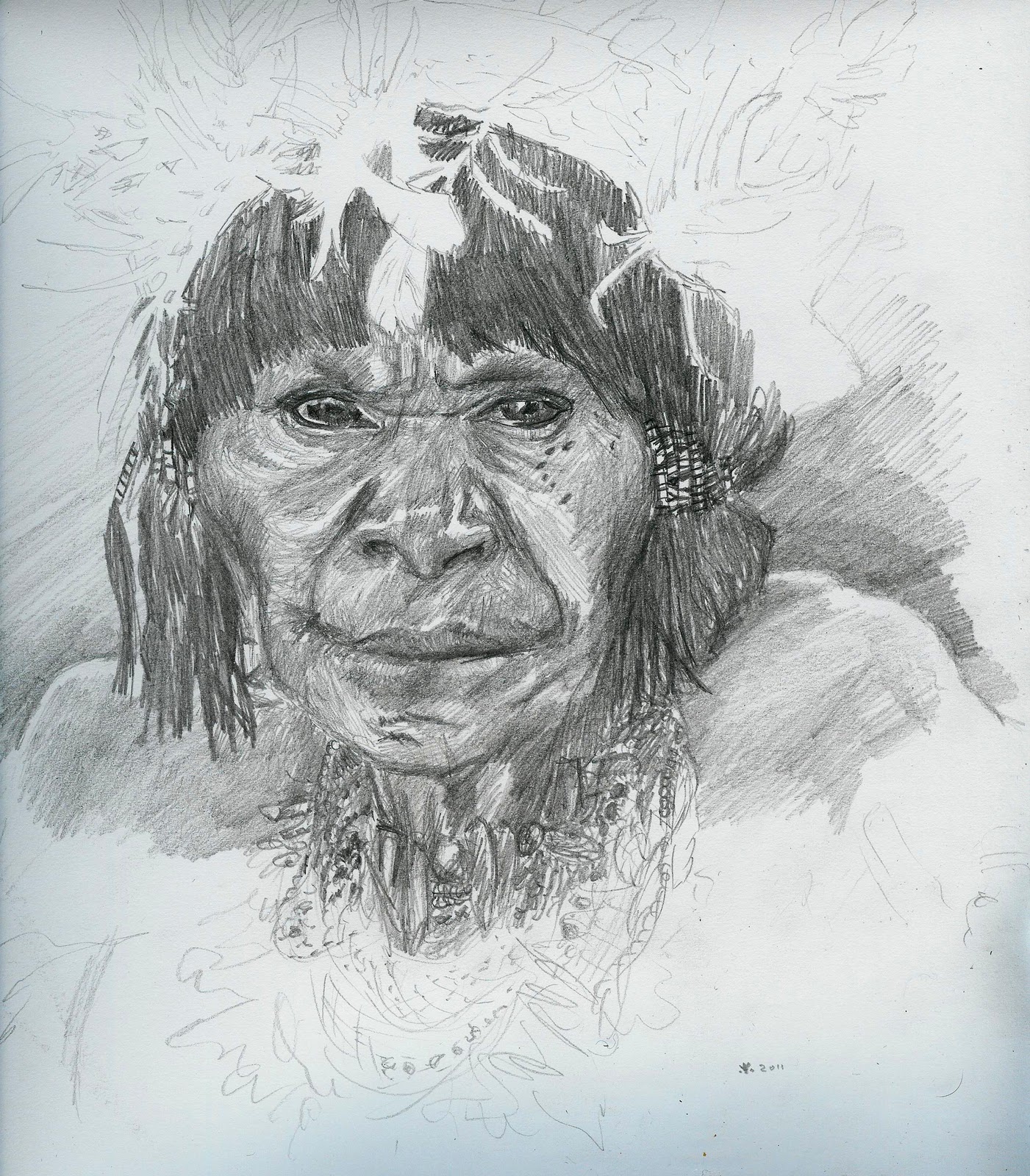
This woman called herself by the trading pseudonym of "Thread Spruce" after a moderate sized spruce that produces fine black thread roots that can be used as a cord. She sat for me in her families hut by the bright light of the lace-working torches. Although they ware thick cloaks and delicate fabrics when outside, they go naked in the warmth of a hut or temple. She is from Cimbowli in the Cochnai, a strip of mountain and coniferous forest that borders the Frayan bog.  The Kreyicians would say she is from one of the 'Civilized Tribes', so called because they live in permanent dwellings, engage in trade and cultivate the summer soils.
"The so called 'civilized tribes' of the Cochnai engage in exquisite crafts.  Gathering the bog-cotton from the western marshes of the Frayan they spin fine cotton threads and knot them into delicate lace using bobbins of polished ivory and pins made of stiff ridge bristles from a local variety of hairy pig. They also make tallow, resin and skin candle lamps, by whose soft light they spend the long winter nights creating lace.

They trade in the north in the summer with the sea-elves and to the south with the few Moryan (gypsy) tribes who venture that way. 

Stip of Cochnai lace
The patterns on the lace are all deeply spirit based - but this is not known my the humans and elves who end up wearing it far away.  To the foreign wearer it is merely swirls, leaves, flowers and animals."

[Here Faadon had attached a number of samples of the lace, but unfortunately for us he seems to have later un-attached them, presumably to ware or give away. Thus we are left only with a few simple remnants to illustrate this craft.]

"The Galmearans of the Cochnai call this trade lace "seed spirits", and trade them with the intention that the appreciation of nature / spirits will be stimulated by those that ware it. In some ways it works.  In the Kreyic border regions where much of it ends up the people believe it is woven by the faeries, and those wearing it must respect the forces of nature.  It has its own quiet cult among the peasants.

When the lace reaches Kreyic it is in the hands of the Moryan (gypsies). The Moryan stick to the border regions as the cultural hegemony is less restrictive here. They themselves have become symbolic of a free society amongst those who are involved in the periodic peasant rebellions and surf uprisings of the territories. As their home is often the green-wood they have become in Kreyician border folklore as equivalent of "the Wild" - a term used to promote a sort of primitivism and an ideal of natural pureness. Given the poverty imposed by land ownership on these oppressed people it is not surprising. The Moryan are sen in direct contrast with the "Dirty Civilization" of the city and castle based inner counties of central Kreyic. 

Some Cochnai lace from the hem of a Kreyician peasants skirt. Unfortunately this old and re-used scrap was acquired from the gallows after a peasant uprising. Its owner was a young woman whose first child had died from malnutrition.  After birthing a second she and her husband had then retreated into the royal hunting forests and built an illegal home where there would be no tax. During this rebellion they where found, and in their home where three wounded rebels she was treating. All the adults where hung, and the boy taken by the kings knights to train to be a man-at-arms or bailiff. I will not say how it was achieved, but that child is now living peacefully with the Moryan in a distant land.

The lace that the Moryan are trading thus became a small token of this rebellion - it was, after all, how many of the Moryan where clad. Surfs and peasants thus adorned themselves in the rich lace and tassels whenever they had any surplice to spend.

Some finer decorated cloth - 'winter plants'
Of course it did occasionally leak up the social hierarchy, but like all aristocratic fashions it quickly faded.  Lower down it persists, and has done for many hundreds of years, the individual animal / leaf / energy symbolism of its creators lost and consumed by a struggle for freedom.  It becomes a symbol for natural non-centralized, non-hierarchical society. In this way the Cochnai creators achieved, partially, their ideas of "seed spirits".

The only major difficulty for the Cochnai Galmearans, if they knew the whole story, was that it also promotes wide spread illegal farming and hunting, which from a balanced natural point of view can be far more destructive than the wild chaises the aristocracy maintain for their personal pleasure.

The people of the Cochnai also make delicate tassels and intricate wood inlays. They create big carvings of deities, but these are not traded. they are "mature spirits".

They farm small areas during the summer for plant food and they milk the semi-domesticated hairy pigs. They live in sedentary villages and maintain a network of pathways.

Cross-section of a temple building.

Front view of a temple building
Their form of nature worship is the most dogmatic and least individualistic of the Galmearan tribes, and involves temples (large hall with a host of carved and dressed deities at one end. They have no priests, but for three moons a year everyone dedicates themselves to worship. In summer it is to the Sun, using trance and fasting, and involves invoking fey spirits. In winter it is a dedication to the Earth, involving meditation. In either spring or autumn, depending on the particular town, it is dedicated to celebrating Plant and Animal life. This involves feasts, social festivals and energetic ceremonies. 

Celebration of Water was also carried out, but how or when or by whom was not disclosed to me, though my wife gave me an infuriatingly knowing look (which she then denied) when I told her of my frustrations in discovering it.  I can only conclude that they told her something of it freely enough, and this is because she is female."

Tuesday, 1 March 2011

Map of the Galmearan freelands, detailing the tribes as defined by the Kreyicians

"Freelands map"

"This dreadful map is one I copied at Dyn Cwmroch in Kreyic, on the eve of invasion, whilst negotiating and inebriating a Kreyic lord.  It has been compiled by both the military magicians of Kreyic using remote sensing and by hostile spies on the ground. as such the tribal divisions are questionable, being based on visual cues and military interactions only.  It is, however horrifyingly accurate given these limitations.  I fear for the future of the Galmearans even more than I did.

It shows the extent to which semi-peaceful co-opting of land by Kreyic in the south has already occurred. Squared town icons are non-Galmearan, doubly squared if walled. Galmearan bases are dots if un-walled, dots with circles if walled and dots with tents if only seasonally occupied. Three dots indicate a ruin.  Only land marked with vegetation or mountains is that considered by her neighbors to be unclaimed by an official nation."


Tribes as defined by Kreyic and their location


The Naya Towwan Mountains (north to south)

The Water Chariot Tribes
(These island dwelling tribes where named after their use of dolphin pulled hide boats.  They interact closely with dolphins in much the same way other Galmearans interact with deer. Somehow, despite the seasonally frozen waters they posses the ability to swim amongst the pack ice. They are a distinct sub-race of Galmearan, the same as the Whale Singer Tribes.)

The Mauljajodd Tribes
(These tribes share ancestry both of the Galmearan Water tribes and Dwarven rebels who fled the Dwarvish Empire over 1000 years ago.  They are the only people I know of to have this interesting mix of ancestry.  They live in shallow natural caves and are astoundingly hardy, especially by Galmearan standards. Most Dwarves and many Galmearans think of them as mystics and visit their oracles. The name derives from the Dwarvish surface Kroltz "Maul Jaðod" meaning "Death Bay")

The Whale Singer Tribes
(These tribes are true mystics of the element of water, from an ancient ancestry that can be traced back across all the migrations of the Galmearan people.  They sing to Whales, including to an ancient Mage in the body of a grey whale who forwent the Magish transition to human form, preferring to stick to that of the larger water realm.)
- The Temple of the Water
(This temple is the latest incarnation of this place, a truly Galmearan affair, woven into the natural fabric of the coast of its island.  Galmearan priest/esses are often seen floating out at sea.  There is also an occasional colony of Mer-people, that rarest of the Magish races, who visit as part of their seasonal migrations.)

The Tribes of Centaurs
(Little is known about these nomadic tribes.  Are they truly a tribe of Galmearan-esk Deer-Centaurs, as the Dwarvish mercenaries reported to Kreyic, or was it a trick of the light?)

The Griffin Riding Tribes
(There are certainly Nobel Griffins breeding here, big enough to bare aloft Galmearans.  They have been reported doing this by Dwarvish spies, but how wide-spread this practice is is unknown. This area is one of very few on the globe where the Nobel Griffin lives.)
- Abooiana
(Being primarily fish eaters the colony of Nobel Griffins and Galmearans nest here together by a large lake, high up in nest dwellings constructed on conifers growing out of cliff faces with creeper walk ropes interconnecting them.)
- Biyiyihya
(This appears to be a smaller, even less accessible version of Abooiana.)

The Cursed Tribes
(So named after their apparent ability to resist all Dwarvish advancement into the mountains. It is known that any undertaking by the Dwarves of the nearby Nordvall goes unaccountably wrong in this area, especially after Galmearans of the Cursed Tribes have been spotted.  Rumors abound that the mountain range is home of that true native life-form of the earth, the living mountains, and inexplicably on this occasion their silicon hive-minds have sided with the Galmearans against the Dwarvish city-states of the Nordvall, Ceamol and Kahn. Certainly the area was once Dwarvish, and the remnants of their ancient empire can still be seen in places - but when the very rock has turned against you no Dwarve can dwell...  It is truly a cursed land.  

The Cursed Tribes have a strong tradition of walking - a long walk is thought to be able to cure all ailments of the mind, and most of the body.  They even have medical practitioners called 'Walkers' who will walk with the afflicted.  The last part of any cure, the walk home or back to the tribe, is always conducted alone - the 'Walker' always takes a separate path.)
- Shard
(A well fortified natural pillar of rock, with shallow caves peppering its flanks like woodworm holes. There are lots of goats about.)
- Keld
(An ancient imperial administrative surface fort used to wage terror and thus control the surface farms and 'wood mines' in the time of the empire.  The upper levels of Keld now serve the Galmearan shamans and warriors of the Cursed Tribes.  They use the fort as a meeting place to learn the ways of their tribes.  Keld still stands on the path of a long imperial tunnel through the mountain range, though the maps of how to use it safely are usually thought to have been long lost.  There is, however, a rumor that Ok's western rebels of the mountain called "the Draran" in The Raheeni still retain this knowledge. The network of surface passes in the mountains around Keld are still maintained by the 'Walkers', albeit in a much narrower and less even form than previously. Many Dwarvish would-be raiders and salvagers have met their deaths in landslides trying to use these apparently sure paths.  In local Dwarvish folklore Keld is the home of Make - the goat daemon of mine collapse.) 


Frayan (north to south)

The Witch Tribes 
(Most of the reports from this area talked of the tribes doing inexplicable things. Since they where unexplainable the spies deduced it must be linked to religious activity of some sort, and as they where known not to have a state or capital city or any other administrative paraphernalia loved by priests they where therefore deemed to be practitioners of witchcraft.  And several of the spies did appear to become possessed and absconded to the other side.)
- The Temple of Fire
(Built in and around an active volcano in a marshland prone to summer fires and random explosive gas events the pilgrims who come here to learn of this element go naked except for a dark paint made of animal fat and soot. They usually have no hair.)

The Wild Tribes 
(This fearsome group of nomads ware oiled skins in winter and moss leg wrappings in winter and have feathers in their hair.  Some have been observed riding giant bog deer - an exceptionally rare species, though most ride elk.  They hunt with otters and are well versed in bow-craft and the use of bolas and the sling. When in combat they come clad in a seemingly impenetrable armor.  How it is manufactured is unknown - but it appears magically strong and light, and slightly flexible.  An area best avoided by the maliciously motivated.)

The Whispering Grass Tribes
(This apparently peaceable group of families living on the long-grassed mosaic of lakes and islands that are the Frayan marshlands dress head to foot in fawn coloured leather. They have short curly hair (unusually for the Galmearans) and lead a seasonal life of secrecy hunting wild water fowl and fish.  They appear to hibernate through the winter in grass globes constructed just before the first snowfall.  In the summer they dwell in small conical tents)  
- Moot
(This is a summer meeting place, by a vast goose colony, where the abundance of eggs and white meat allow a festival to occur. On one occasion the Kreyician spies did observe it being broken up by a marauding party of bears.  Instead of fighting them or scaring them off the people simply took to the water in skin boats and waited until the bears went, some two days later.  The festivities where then resumed.)

The Daemon Tribes
(Only one Kreyician spy returned from this area, and he was mad.)
- Inishamayan
(Amongst his incoherent babalings the spy mentioned dances carried out on this island. To quote him "There they hungry are, WATCH OUT! Dancing like the cranes, their beaks - oh their beaks - They called the island Inishamayan I tell you!  Inishamayan - don't go near if you value you pizzle! AND WATCH FOR THE EYES!!  Oh the eyes!  Tall as houses. Oh the eyes... Slender they are, red and black and white and the colour of flesh...  All up and down and no sideways, like lines of rain in the grass. That daemon island, those dancers, KEEP AWAY, cant keep away, stay BACK, I CANT!! ohhh ohhh...  Breasts like eggshell, nipples like flame. OH THE EYES!!!  Watch for the eyes my friend - the cranes will eat them as you stare like onions - and your lolling leching tongue - peck peck peck PECK!!! AGHHHHHHHHHH!!!!  I swam away I swam away I was hungry I wanted the bulrush roots so I swam but the burning beaks followed me they stilted followering yab yab ligaaaa!....
Is that a duck pie?  Yum.")


The Clay-god Tribes
("These tribes appear to worship clay idols that they build around the marsh.  They are usually formless and hollow, fired from the inside without expertise. The clever among them occasionally build small temples around the mightiest of them, though most are allowed to weather outside back to the soil. They constantly seem to be in search of new gods as the ones they have do not appear satisfactory.  They are thus considered a particularly unintelligent and stupidly focused set of tribes. simple military tactics should deal with them swiftly" - Kreyician spy report. I happen to know from personal experience that these "clay-gods" are in fact chimneys from winter hibernation huts.  Structurally they only last one season, so the huts are ceremonially burnt and the crumbling chimneys are abandoned each year, when a new area with fresh driftwood fuel is moved to in the subsequent winter.  They are in fact more intelligent than most Galmearans in their management of resources.  Almost none die in winter.  Their Gods are not their chimneys (they are animists, so their chimneys do have spirits) instead being part of the most common Galmearan pantheon, that with the family of Earth, Sun, Water, Greenwood and Fire at its head.)


Cochnai 

The Civilized Tribes
- Nanda
- Cimbowli
- Ilmolio
- Aataifohegil
- A'Eatabooa
- Pirooahie
- Bwenan I'Sowin


Shenambi Forest (north to south)

The Fish Eater Tribes
- Burilis

The Red Axe Tribes
- Naratacea


The Cloud Weaver Tribes


Estoadai Grasses

The Blue Axe Tribes
- Eianae
- Olkie


The Raheeni (The Inertia)

The Tented Tribes
- Shelaada

The Noble Tribes
- Lismad
- Lowea

The Sluttish Tribes
- MaBrae Staa

(Ok's Western Rebles - isolated Dwarvish Hive
- The Draran)


The Vay Mountains (north to south)

The Tall Tribes 

The Dark Path Tribes
- Thiow Thiow
- Chiooriss

The Canny Tribes
- Agwan
- Deer Avon


The Wild Wood

The Deep Tribes
- Greenwood Temple

The Tribes of Death


The Higher Grasses (north to south)

Nomadic Tribes

The Daemon Music Tribes
- Uradeur
- Earth Temple / Temple of the Deep Earth
- The Colmarsh
- Dihrlarm


Mwnnwdd Abeata Hills 

The Weapon-maker Tribes
- Old Red
- Old Black


The Middle Grasses

The Incense Tribes
-Matalean


The Eastern Forests

(Blackbeard's Eastern Rebles
- Urikjolt

The Featherheads
- Tamdrey


Hobdowns

No permanent tribes
- Teash Traiding Camp


Shi Hills

The Tribes of the Cities of the Skies 
- Minx


The Dark Woods

The Leafbright Tribes
- Gaeib


Marrin Hills (east to west)

Tribes of Spears 
- Felt
Shining Tribes


Drisghol Hills (east to west)

The Many Coloured Tribes
- Grange Mass
Man-mother Tribes


Lliddydram Woods

The Invisible Tribes
- Ambara


Vayrean Hills

The Weak Tribes
Deep Oak (north to south)

The Hiding Ones
- Moss 

The Tribes of Many Arrows

The Tree-hut Tribes
- Ameahga
- The Last House


The Lower Grasses

Ceolarai Forest (north to south)

Gypsy Tribes

Bandit Tribes
- Ealosai

The Faceless Tribes


The Cortez Mountains

The Far Away Tribes


Some scetches and notes on the Difani, or 'Tall Tribes', of the Galmearans

"Portrait of Shinka of the Difani"
"Shinka of the Difani on New Defences"

 Fragment #1

"Shinka of the Difani on New Defences
From what the Humans call "The Tall Tribes"

- Short hair from cutting to weave into fabrics - energetic signature of artist - cut every 9 years. Peoples age sets are defined by this.

"Quilted panel -  dyed fine woven rabbit wool."
Quilted panel

(Dyed fine woven rabbit wool)

[anti-clockwise from top left]

* Black Berry (belly-button)

* Red Berry

* Pink-white shell

* Representing Deer

* Galmearan
(Dark-green nettle cord knots)

* Black/brown

* Dark brown

* Light green

* Light brown

* Light brown-green

* Light green

* Light green / dark yellow

*Dark yellow"


"A Difani Blade" - an Eashay

 Fragment # 2

"A Difani warrior always keeps a hand on their weapon - partly this allows rapid drawing, partly it serves as a reminder of their role, and partly it is because being unsheathed they would otherwise stab your legs when you ran or sat down...

The Difani do not use scabbards as such, instead resorting to platted string. Great skill is needed to draw the blade smoothly. This ensures both that no-one carries a blade without good training and also it makes it almost imposable to draw someone elses blade.

Ever economical and resourceful, the people of Defani have developed their weaponry from their tools.

This blade, called an Eashay, is very close in design to the tool they use to prune and coppice the hazel and a small but well thorned tree, local to the area, called naois. Naois buds are gathered, dried and powdered to be snorted like snuff. This aids concentration when weaving.

The original tool has a lighter handle and no blade other than the saw.

The steel used is Dwarvish, and thus of the highest quality. The people of Diffani trade woven cloth and embroideries for their imports.

Imports include the aforementioned Dwarvish steel, as well as some Dwarvish rock powders used to colour and fix their bright cloths.  They also trade with other Galmearan tribes for forest colours and for some of the raw wools they then spin and weave. Noticeable among these are rabbit wool and deer fawn under-wool, as well as certain dried lichens.  They also use bog-cotton and other grass-stem fibers that are gathered originally by the bog-hoppers of Llanwern as well as those Galmearans in the "Frayan" marshes to the north.  Their must be an extensive inter-tribe network across the Freelands that bring the goods to the mountains.  Of course no coin would be used, being Galmearans, so all trade would be barter based. 

One day I will follow the bog-cotton from Teash trading camp just over the Llanwern border, and see where I end up, and if I survive the wild tribes and the death tribes the Human spies seem to fear so much..."

"Naois"


Fragment # 3

"Naois.

"Naois Flower - drawn with experimenal
pallet - not a success."
Naois grows naturally as a single maiden, up to 6 legs (24 hands) tall - this is roughly 18 feet using the common measurment. However, as the flowers (and their harvestably mind-focusing buds) grow only in carnivorous lesions on the third-year wood the Galmearans of Difani first coppice the tree every five years for four consecutive seasons, until an ideal of 30-40 stems are shooting from the base. These are then pollarded at roughly three hands. Each year the stupor inducing thorns are meticulously pruned off with great care."
 

Tuesday, 15 February 2011

A breif history of the Galmearans (slight nudity)

Galmearan Elder calling herself 'Milkweed' of one of the 'Shadow Tribes'

Note scrawled in margin-

"First draft. This is how I understand it anyway.  I gained my knowledge from the Abail Elves and by talking to a Galmearan elder calling herself 'Milkweed' of the one of the 'Shadow Tribes' (as the Kreyicians would name them). I have sketched her on the reverse of this page. Being almost 60 she is very old for a Galmearan, and very fond of hot herbal infusions."

In a book of notes for various books -

            "Long, long ago, at a time when the Dwarven empire still straddled the globe and humans had yet to land on the coast of Ottarol there lived a race of people named the Galmearans. Born of Elvish ancestry they treated the forest as their home and all beings as their family.  Standing at most at 5 feet high their slight frame seldom left any sign of their passing and few people even knew of their existence.

          And so it would have continued if it had not been for the insatiable hunger of the Dwarven empire for wood to fuel her furnaces and food to feed her workers.  Having devoured the forests west of her the ravenous empire turned her eyes south to the seemingly deserted forests of the Galmearans.  Being a peaceful and dispersed folk the Galmearans failed to recognize the danger until it was too late.  With Dwarven axes at their heels the Galmearans fled north beyond the leafy bows of Gaer to the dense forest that used to stand on the land of Kreyic.  

          For many hundreds of years the Galmearans lived in peace and solitude in the dark woods of Kreyic.  They had learned the bitter lesson of survival the hard way and haunted the trees the way spirits might do, terrifying anyone who dared set foot on the soft loam of their forests with an elaborate system of switch back paths and traps.  They also started learning the arts of war such as archery and knife craft.  Soon such Myth had grown up about the forests that no soul who valued their future would enter.

          Sadly the very thing that saved their lives also sealed there fate.  Humans from the continent of Tuyun landed on Ottarol’s eastern shore at Brach.  Being men of grand ideas the leaders at once made war with the Elves hoping to steal their lands.  Though the humans had much steel and magic they where ill knowledged on the Elves of Gaer.  The humans of Brach found their own numbers severely lacking and the dream of a quick victory turned in to a long, long battle.  After several decades of war the humans eventually acknowledged defeat and the elves banished the remainder of the army to the haunted forests of Kreyic.  Although severely reduced in number the Kreyic army was still large enough to hold off the Galmearans and form their own kingdom.

          The Kreyician humans expanded to the sea in the east, the plateau in the west and Gaer in the south and so yet again the Galmearans where pushed north, wedged between the collapsing Dwarven empire and Kreyic.  And so they still reside, piteously few in number held in the last large tract of 'uninhabited' forest on Ottarol.  

          Kreyic prospered, her wealth known the width and breadth of Ottarol.  Peace rained with her gentle hand for a thousand years or so until the west wind sent a parcel of hunger across the plateau to Kreyic.  Tens of thousands of locusts descended of the fertile land of Kreyic.  Soon starvation swept the land and all went hungry.  In the desperate quest to search for a cure to this pestilence Kreyic turned her eyes to her neighbors and so she noticed the silent haunted forests of the Galmearans that lye in the north where the locusts could not go.  And so yet again the lands of the silent folk was under threat from outside.
Woman of the 'Shadow Tribes'

          This is the history of the Galmearans, of how they came to be where they are and, although they hold no grudges, of whom they must be wary.   This tale paves the way for many others for at this point so begins the War of the Mistake, the war that could so easily have wiped out the dryads of the forests, the Galmearans."

Tuesday, 8 February 2011

The Magish Alphabet

Magish alphabet
[From 'An Anthology of the World']
 
"Appendix 3

Alphabets

Magish (old common) Magish

Magish is the ancestor of modern common, and follows the same rules. It's still used on Partway Island and some Tuyun Countries and, of course, by the Mage's.  It is divided into five Families, usually arranged in a circle with G at it's center.

X H E C N / M W S Z N V / U L O K A / Y T I J F / R B Q P D

The numbers used with this alphabet is based on the number of corners they contain : -

1 2 3 4 5 6 7 8 9 0


[Most people who can read modern common with ease can also interpret Magish, given a few moments contemplation.

The red decorations are as follows -

Top-left - Old Gaer symbol of the sun; 

Top-right - Old Gaer symbol of the moon. The Calobelvan written around it reads - "- Shal (Sun) - Car (Tree/Truth) - Aer (Ground) - Ash (Water) - Ath (Sky) - Mhoor (Spirit) -" (presented together they mean balance)

Left border - Sand-Dwarvish pattern, also found on some Galmearan materials.

Right border - Modern Gaer (Elvish) design, used frequently.
(These two pattern presented as complimentary patterns indicate the breadth of alphabets covered in Appendix 3, coming from almost opposite types of societies and races]

Tuesday, 1 February 2011

Cara and the Running of the Deer

"Cara - a Galmearan at the Temple of the High Sun"
"Cara - a Galmearan at the Temple of the High Sun, preforming a ceremonial rite called "The running of the Deer".  This seasonal right is preformed in late spring, and is in veneration of the end of the Hungry Spring and the coming of the Bounteous Spring.  

The ceremony starts the night before with a fine feast of new fresh food and a long sleep by a warm fire.  


Galmearan
Then, before the sun is up both Galmearan and deer take to the forest floor.  The Galmearns where cloaks of leaves and have masks that are made up to look like deer, and bare a symbol of the sun on their brow.  The stags amongst the deer have their velvet covered antler buds gently bedecked in moss. Those who use magic to retain their antlers year on year will through moss from the ground all over the heard.  

The day is then spent running from sunny glade to sunny glade in a sort of hide and seek / tag with the sun and each other. There may be more to it than this, but I could not get any sense from anyone, except that at some point honey is consumed. 

I have no idea what they do if it rains, though my guess is that the day is not date dependent.

Cara, the Galmearn pictured here, paused long enough to be drawn. I had met her on a previous visit to the Freelands when she was a girl, siting by the fire one night in the border lands of Kreyic while me and her parents had traded skins for long knives.  She and my son Eshran communicated, as children can, without the use of words. I still have the crude wooden deer they devised from a pine cone. I was amazed to find her again and have the pleasure of seeing her grown  into her own person and enjoying the theatrical delights of the Temple of the High sun - the closest Galmearans have to a city dwelling.

The infectious glee of the day was hard to contain, and as Cara ran off after a passing troop of galloping and bellowing deer I found myself yelping with laughter and spinning madly on the spot at the joy of being alive. 

Red Deer Hind
If it hadn't have been for that wild moment I doubt the wild boar would have minded my presence, nor that beautiful red hind have found me and carried me to safety on the most exhilarating ride of my life.  There is nothing like a face full after face full of leaves at 50 miles to the hour to get the blood flowing and the heart thumping.  I know now a little of why so many Galmearans are addicted to riding deer!

At the end of the day somehow rider and deer have found each other, and the Galmearnan-less deer and the deer-less Galmearans have generally paired up for the day and everyone (including very small children) charges thought the woodland at breakneck speed to the top of the biggest hill to watch the sun set. A great cheering and bellowing goes up from the time the sun touches the horizon to when it finally vanishes behind it, rising up the hilltop as the graying light first touches those lower down till at last the tallest Galmearan standing on the  antlers of the largest stag at the hills crest is cast into the shadows and silence. Everyone then melts back into the darkness with the stealth that only deer and Galmearans can master.  I do not know where they went.  It took me two days to find my way back to the temple - my Gods was I hungry!"

Wednesday, 26 January 2011

Book of "Ddoe" (Everything) - Introduction

[This introduction has many paragraphs in an Elvish tongue that can be quite hard for those used to the common tongue. Please bare with it. If it is too much of a challenge, simply enjoy the pictures.

This unfinished book appears to have been destined for the Library of the Mage of Waun-Fach. It was a joint collaboration across races, for which this was a second draft - an attempt to set out the illustrations and text.  Unfortunately this version, condemned to the basket of Faadon Naano, was incomplete. Faadon's connection to the book is through Pip Cerrig, his nephew.  Pips father is Karl Cerrig, the map maker of Kreyic who is either Faadon's brother or half brother. Certainly for a man that high up in the hierarchy of human Kreyic Karl seems to have an unusual touch of the Elvish about him, and cannot bring himself to live too long away from the sea...]


Front Cover

Front cover of "Ddoe"

"Ddoe" [Dd pronounced as in a hard Th]

[Gaer Elvish (Calobelvan) translation - "Everything"] 


Page 1

Page 1 of  "Ddoe"

"Ddoe - 1(12)(11)3(11) - Lalsadaceocal"

Gaer Elvish (Calobelvan) Translation - 

"Everything - 39,915 [years] away from creation"


"Everything - 22222 AC"

[A.C. = "After creation" - Quite a discrepancy!  I suspect Human/Elvish disagreement!]


"Vaga ma negal enimova o mo fuaninanl enimofuain o Abalyo nuf mo ilmiranke o mo Shamail astaen; mo Grit Pip Serig o Glascwm Mawth, enimopinscfoarinan o Craic; Aarrddc, ma Dongil enemofoarin; Tad, ma Grit lwis; and Ewis, ma Galimean lalins.

~*~

Ddade:- Mo o ar nuf enimov o mo astaen o lara ar fi o fechmhoor ig sadar mo erins o lara cal met a ceremay erin astaen o mo ca ma blar sadar foarin o lara mhor."


Direct Translation from Gaer Elvish (Calobelvan) to the common tongue -


"Of a combined writing of the master scholars of  Abalyo use[ing] the broken-birth of the Sharmail [Priest-meeting spot]  ?Library?; the Human Pip Cerrig of Glascwm Mouth, 'out-loud reader' of Kreyic; Orddk, the Dwarvish scholar; Tad the Human nomad; and Ewis, a Galmearan refugee.

~*~

Quest:- the because is use writing of the knowledge of all is known of the history flow, towards the present of all folk are, and help build knowledge of the many a soul/spirituality towards the mastery/full knowledge of all spirits/will. "

"Sharmail"
 [The illustration shows an interpretation of the old writing houses of Sharmail, where on warm still days the side panels of the room could be removed to allow the light in.  This scholar and his room show some classic examples of grown furniture and architecture. In some cases additions to the library where planned three generations in advance in order to allow the correct pieces to be grown. You can see here the prominent use of tree-nails. Above the scholar on the wall are a few of the old spirit-signs of the Elvish people. This picture is late in the day for Sharmail, for it depicts the use of iron bindings, and more importantly, of books. Early Sharmail only housed scrolls.]


Page 2
Page 2 of "Everything"
"Ce O Mo Enimova"

Direct Translation from Gaer Elvish (Calobelvan) to the common tongue -  
 
"Birth Of The Writing"


"Origins of the writing.  

The Elves of Abailgor used the part of the library that was taken from Sharmail, seat of Gaer-Elvish knowledge since pre-6000AC. in 20882AC, when Wingaer dissolved, to Abailgor, the peace-meeting site of all the ancient families of northern old Gaer. This contains snippets of knowledge from the ethereal Mage Monilan [Mage-sign], who has long deserted the Elvish Shore. They also used the extensive annuls of the guardians of Aldurelws, who met with many travelers, including the Galmearan, as they passed through the pass of Minabiag and recorded these tales for posterity... 

Other sources used where:- 

The library of Pip Cerrig, being compiled over many centuries by his family and thought to be the largest in Kreyic;  

The open parts of the libraries of Waun-Fach and Tiron, the former thought to be the most comprhensive on Ottarol, and the latter containing most of the languages ever spoken and many more besides;

The minds of Orddk and Ewis, who hold the history of their people, and that of Tad, who has also many tales from teh more removed parts of the east. 

Pip Cerrig."


[Some discussion on illustrations and symbols -

 There are three Mage-signs used. Monilan's is in its origional form , while Tiron and Waun-Fach are both slightly elaborated. Waun-Fach is thought to have got his sign from the ear of the silver Lynx, his preferred host before the coming of Humans.  Tiron is thought to be linked to Wood-Sorrel, but no-one knows why. Very little is known of Monilan.

Mage-signs are used when writing about Mages as they use shape rather than sound in the Faerie dimensions to communicate.

Tiron Mage-sign
Monilan Mage-sign
Waun-Fach Mage-sign

This Rune of dragonic protection (bellow) is used frequently by Elvish, Dwarvish and some Human cultures. It represents the balance of the Physical, Conscious and Faerie.

Dragonic Rune of Protection

Karl Cerrig is the father of Pip Cerrig, and Pip continues to use his fathers logo on his official projects.  the use of Faadon Naano's logo is interesting. Although he is not credited for this project the use of his sign, coupled with the fact that this book has turned up in a collection of his old notes, suggest he was intimately connected with it...
 
Faadon Naano's sign
Karl and Pip Cerrig's sign

This picture is of the group working around a round table.  Orddk is on the left, then comes Pip, then Ewis, then an inebriated Tad. The style of the archetecture suggest they are at Pips house in Glascombe Mouth, Kreyic. As the Abailgor elves would not travel this far it begs the question - who did the drawing? Could it have been Faadon Naano?]

Around the round table

Abailgor? Or Sharmail...?

Page 3


Portraits of the writers
[The dry fallen leaves represent the old leaves of paper used to compile the text. The snake, with its triple tongue, hinting at the Dragonic rune of protection, represents a renewal of these old texts, a sloughing of old hardened skin of rivalry and a restoration of balance.]


Ewis

[Ewis is depicted with the mountains of Nazuoralnitotzu in the background, returning to the old hunting grounds of her people and living off the rich fruit that grow there.]

Orddk

[Orddk is pictured in a Dwarvish doorway at Farin, just inside Darngaer, where he comes from. This is a place of peace in the face of hostilities from all surrounding people, a mixing place for Elish, Human and Dwarvish traders. Above his head is the goat god who terrifies the superstitiouse Dwarvish miners. The only thing that scares this god of mine colapse is his own image, hence it is everywhere in Dwarvish towns around Nazuralnitotzu.]

Pip Cerrig

[Pip Cerrig depicted in the simple robes in fashion at the moment in Kreyic, with a background of one of the shelves of his library.]


Tad
[Tad is a Moryan, a 'Gypsy' as some say.  Her name is not her real one - as with all Moryan to avoid trouble they use pseudonyms based on their real names. Her pseudonym, she has said on occasion, is a shortening of Tadpole, but no-one believes her.  Here she is seen growling at the illustrator, a typical pose for this player of theater. Behind her is one of the vans of her people. Undoubtedly it is not hers. No Moryan would want to go down in print with too much reality around  them encase it turned around and bit her.]


The Abail Elves
[This is a group portrait of some of the Elves who helped with the book. Typically for their people not only are the scholars depicted, but so are the fisher-people who fed them, the camouflaged warrior who guarded them and hose-keeper who cooked and cleaned for them. On Abail all these duties are considered necessary parts of writing a book.]