Showing posts with label Kreyic. Show all posts

Tuesday, 22 March 2011

Some rambeling notes on the Galmearan tribes of the Cochnai

This woman called herself by the trading pseudonym of "Thread Spruce" after a moderate sized spruce that produces fine black thread roots that can be used as a cord. She sat for me in her families hut by the bright light of the lace-working torches. Although they ware thick cloaks and delicate fabrics when outside, they go naked in the warmth of a hut or temple. She is from Cimbowli in the Cochnai, a strip of mountain and coniferous forest that borders the Frayan bog.  The Kreyicians would say she is from one of the 'Civilized Tribes', so called because they live in permanent dwellings, engage in trade and cultivate the summer soils.
"The so called 'civilized tribes' of the Cochnai engage in exquisite crafts.  Gathering the bog-cotton from the western marshes of the Frayan they spin fine cotton threads and knot them into delicate lace using bobbins of polished ivory and pins made of stiff ridge bristles from a local variety of hairy pig. They also make tallow, resin and skin candle lamps, by whose soft light they spend the long winter nights creating lace.

They trade in the north in the summer with the sea-elves and to the south with the few Moryan (gypsy) tribes who venture that way. 

Stip of Cochnai lace
The patterns on the lace are all deeply spirit based - but this is not known my the humans and elves who end up wearing it far away.  To the foreign wearer it is merely swirls, leaves, flowers and animals."

[Here Faadon had attached a number of samples of the lace, but unfortunately for us he seems to have later un-attached them, presumably to ware or give away. Thus we are left only with a few simple remnants to illustrate this craft.]

"The Galmearans of the Cochnai call this trade lace "seed spirits", and trade them with the intention that the appreciation of nature / spirits will be stimulated by those that ware it. In some ways it works.  In the Kreyic border regions where much of it ends up the people believe it is woven by the faeries, and those wearing it must respect the forces of nature.  It has its own quiet cult among the peasants.

When the lace reaches Kreyic it is in the hands of the Moryan (gypsies). The Moryan stick to the border regions as the cultural hegemony is less restrictive here. They themselves have become symbolic of a free society amongst those who are involved in the periodic peasant rebellions and surf uprisings of the territories. As their home is often the green-wood they have become in Kreyician border folklore as equivalent of "the Wild" - a term used to promote a sort of primitivism and an ideal of natural pureness. Given the poverty imposed by land ownership on these oppressed people it is not surprising. The Moryan are sen in direct contrast with the "Dirty Civilization" of the city and castle based inner counties of central Kreyic. 

Some Cochnai lace from the hem of a Kreyician peasants skirt. Unfortunately this old and re-used scrap was acquired from the gallows after a peasant uprising. Its owner was a young woman whose first child had died from malnutrition.  After birthing a second she and her husband had then retreated into the royal hunting forests and built an illegal home where there would be no tax. During this rebellion they where found, and in their home where three wounded rebels she was treating. All the adults where hung, and the boy taken by the kings knights to train to be a man-at-arms or bailiff. I will not say how it was achieved, but that child is now living peacefully with the Moryan in a distant land.

The lace that the Moryan are trading thus became a small token of this rebellion - it was, after all, how many of the Moryan where clad. Surfs and peasants thus adorned themselves in the rich lace and tassels whenever they had any surplice to spend.

Some finer decorated cloth - 'winter plants'
Of course it did occasionally leak up the social hierarchy, but like all aristocratic fashions it quickly faded.  Lower down it persists, and has done for many hundreds of years, the individual animal / leaf / energy symbolism of its creators lost and consumed by a struggle for freedom.  It becomes a symbol for natural non-centralized, non-hierarchical society. In this way the Cochnai creators achieved, partially, their ideas of "seed spirits".

The only major difficulty for the Cochnai Galmearans, if they knew the whole story, was that it also promotes wide spread illegal farming and hunting, which from a balanced natural point of view can be far more destructive than the wild chaises the aristocracy maintain for their personal pleasure.

The people of the Cochnai also make delicate tassels and intricate wood inlays. They create big carvings of deities, but these are not traded. they are "mature spirits".

They farm small areas during the summer for plant food and they milk the semi-domesticated hairy pigs. They live in sedentary villages and maintain a network of pathways.

Cross-section of a temple building.

Front view of a temple building
Their form of nature worship is the most dogmatic and least individualistic of the Galmearan tribes, and involves temples (large hall with a host of carved and dressed deities at one end. They have no priests, but for three moons a year everyone dedicates themselves to worship. In summer it is to the Sun, using trance and fasting, and involves invoking fey spirits. In winter it is a dedication to the Earth, involving meditation. In either spring or autumn, depending on the particular town, it is dedicated to celebrating Plant and Animal life. This involves feasts, social festivals and energetic ceremonies. 

Celebration of Water was also carried out, but how or when or by whom was not disclosed to me, though my wife gave me an infuriatingly knowing look (which she then denied) when I told her of my frustrations in discovering it.  I can only conclude that they told her something of it freely enough, and this is because she is female."

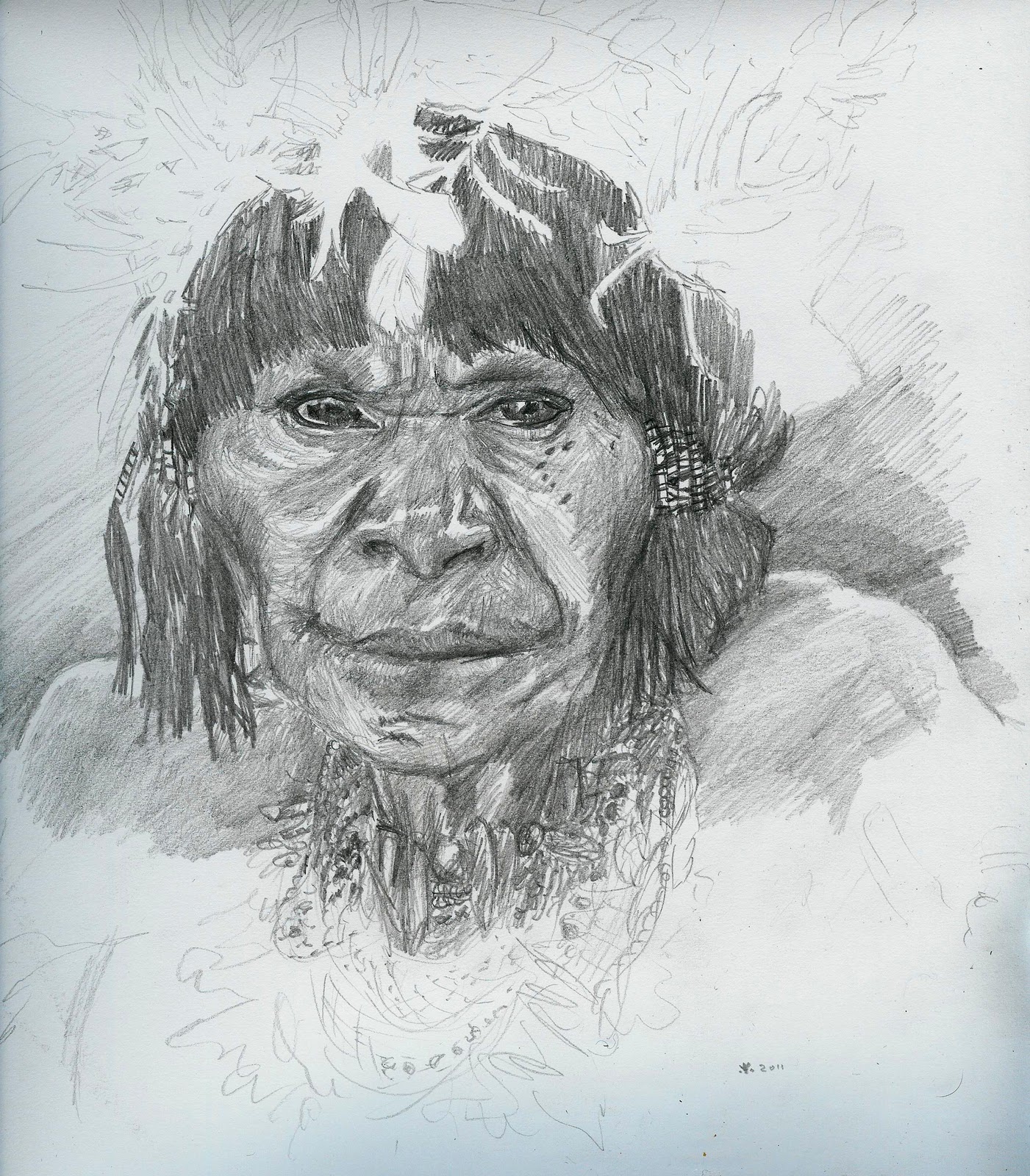
Tuesday, 15 February 2011

A breif history of the Galmearans (slight nudity)

Galmearan Elder calling herself 'Milkweed' of one of the 'Shadow Tribes'

Note scrawled in margin-

"First draft. This is how I understand it anyway.  I gained my knowledge from the Abail Elves and by talking to a Galmearan elder calling herself 'Milkweed' of the one of the 'Shadow Tribes' (as the Kreyicians would name them). I have sketched her on the reverse of this page. Being almost 60 she is very old for a Galmearan, and very fond of hot herbal infusions."

In a book of notes for various books -

            "Long, long ago, at a time when the Dwarven empire still straddled the globe and humans had yet to land on the coast of Ottarol there lived a race of people named the Galmearans. Born of Elvish ancestry they treated the forest as their home and all beings as their family.  Standing at most at 5 feet high their slight frame seldom left any sign of their passing and few people even knew of their existence.

          And so it would have continued if it had not been for the insatiable hunger of the Dwarven empire for wood to fuel her furnaces and food to feed her workers.  Having devoured the forests west of her the ravenous empire turned her eyes south to the seemingly deserted forests of the Galmearans.  Being a peaceful and dispersed folk the Galmearans failed to recognize the danger until it was too late.  With Dwarven axes at their heels the Galmearans fled north beyond the leafy bows of Gaer to the dense forest that used to stand on the land of Kreyic.  

          For many hundreds of years the Galmearans lived in peace and solitude in the dark woods of Kreyic.  They had learned the bitter lesson of survival the hard way and haunted the trees the way spirits might do, terrifying anyone who dared set foot on the soft loam of their forests with an elaborate system of switch back paths and traps.  They also started learning the arts of war such as archery and knife craft.  Soon such Myth had grown up about the forests that no soul who valued their future would enter.

          Sadly the very thing that saved their lives also sealed there fate.  Humans from the continent of Tuyun landed on Ottarol’s eastern shore at Brach.  Being men of grand ideas the leaders at once made war with the Elves hoping to steal their lands.  Though the humans had much steel and magic they where ill knowledged on the Elves of Gaer.  The humans of Brach found their own numbers severely lacking and the dream of a quick victory turned in to a long, long battle.  After several decades of war the humans eventually acknowledged defeat and the elves banished the remainder of the army to the haunted forests of Kreyic.  Although severely reduced in number the Kreyic army was still large enough to hold off the Galmearans and form their own kingdom.

          The Kreyician humans expanded to the sea in the east, the plateau in the west and Gaer in the south and so yet again the Galmearans where pushed north, wedged between the collapsing Dwarven empire and Kreyic.  And so they still reside, piteously few in number held in the last large tract of 'uninhabited' forest on Ottarol.  

          Kreyic prospered, her wealth known the width and breadth of Ottarol.  Peace rained with her gentle hand for a thousand years or so until the west wind sent a parcel of hunger across the plateau to Kreyic.  Tens of thousands of locusts descended of the fertile land of Kreyic.  Soon starvation swept the land and all went hungry.  In the desperate quest to search for a cure to this pestilence Kreyic turned her eyes to her neighbors and so she noticed the silent haunted forests of the Galmearans that lye in the north where the locusts could not go.  And so yet again the lands of the silent folk was under threat from outside.
Woman of the 'Shadow Tribes'

          This is the history of the Galmearans, of how they came to be where they are and, although they hold no grudges, of whom they must be wary.   This tale paves the way for many others for at this point so begins the War of the Mistake, the war that could so easily have wiped out the dryads of the forests, the Galmearans."

Thursday, 27 January 2011

Pressed Flowers

 [These two pages of pressed flowers where found in a half finished anthology of cartography, sandwiched between a political diagram of Kreyic and a large attempt to map all of north eastern Ottarol.  I have no idea why he collected them, but Faadon Naano seems a dreamy kind of a fellow, given to following his fancies...]


"Herbs from the forests of Mwn, in Kreyic."
 Fragment #1

"A few herbs from the forests of Mwn, in Kreyic, collected one time when my brother said a prince had 'summoned' me for some kind of tedious address thing. In a few ways I regret not going. Getting my boat - Acreshi - out of that Human harbor unscathed took quite a bit of planning, what with all those bailiffs and guards all over her, but it had been such a lovely sunny day for a walk, and the woodlands looked so appealing... Still, at least that boring prince never got to see my face, should we ever cross paths again!  My brother is still angry about it though. Cost him an illustrated map of the forests to cheer that prince up again - said it took him two months just walking the ground!"

"Medical herbs collected in Zingomoogaer."


Fragment #2

"A few medical herbs collected in Zingomoogaer from an olive grove in spring.  The Elvish folk here are so much more to my temperament than those stuffy Human nobles. Is it not the case that a lazy evening by a bonfire is a far more pleasurable place to quaff ale than some dusty hall full of speeches and etiquette and standing up and sitting down on command? 

Having said that, an anonymous looking Elvish tribal leader insisted that I attend some kind of solemn crop blessing thing tomorrow at noon, all long chants and intense 'meaningful' expressions, so it looks like an early start. The tide turns an hour before dawn..."