Showing posts with label Nazoralnitotzu. Show all posts

Friday, 11 February 2011

A breif encounter with some Dwarvish industrial music

Parts of some sub-machine melodic instruments.
"I was, it has to be said, snooping around when I encountered these fragments of the deep forges.  I  had previously spent my time at Nordemriecargor politely engaged in barter, but as the second day of discussion over the comparative worth of silver and coconuts drew to a close my eyes where aching for the sun, and my lungs for previously unbreathed air. I should, I suppose, have stuck to my Dwarvish minder, but in need of mischief I soon gave the poor surface-dazzled miner the slip, and chose my path with will-full abandon.  I soon found myself following some unusual booming noises to a largish shaft and wheel. 

Outside two highly skilled but rather tetchy upper-class Dwarves where tinkering with some gaudily painted mettle tubing. Finding a comfortable spot among the vegetation free scree I sat and did the quick sketch overleaf [above]. Having good sharp hearing from my Elvish ancestry, and a rudimentary understanding of Kroltz from my time in the southern mines such as Stordonafagel (these northern Nazouralians being above such plebeian activities as speaking 'common') I was able to ascertain the purpose of the pipes.

In the Kingdoms and Queendoms bellow there are (as I had imagined) vast workshops, forges and foundries. These often employ up to two hundred or so Dwarves, all engaged in the noisy practicing of their arts. In some there are, as well as the beating of many hand held hammers, the pounding of great water-driven forge hammers, whose blows can reverberate throughout the entire hive.  In order to keep focused on the work in hand it is a convention that all work to the rhythm of these vast hammers, entering a sort of meditative trance.  It has been found in certain hives (such as at Nordemriecargor) that this can be enhanced further by the introduction of a melodic element. This is improvised around the central rhythm in order that this rhythm does not become soporific.

Of course the instruments in question need to be very loud, using scale, magic and certain alloys in order to amplify them adequately. This is what the acoustic engineers (as the two artisan Dwarves turned out to be) where doing on the surface, away from the interfering beat of the hammers.  The instrument parts had been lifted up a series of vertical wheel driven shafts. 

The instruments themselves seemed to consist of some sort of trumpeted harp; part of an array of paddle beaten pipes; and one of a series of water-power driven bellows used to play some kind of over-sized and over engineered whistle.  This instrument the two Dwarves talked about in such passion and technical detail I was unable to get more than the vaguest notion of what it was like.  All the instruments where painted in bright colours.

Unfortunately for me, before I could embark on a more detailed drawing I accidentally dislodged a stone with my foot and the sharp-eared Dwarves spotted me. I hailed them and approached in what I hoped was a nonchalantly friendly manner. They did not respond well.

More fortunately for me, before they had actually reached me (I think with the intention of testing their drawn war-axes on my skull) my bumbling minder also arrived on the scene and apologetically led me away backwards, his face draining of all colour as he bowed repeatedly to the two artisans, placing gold coins for them on the floor. 

He then insisted I did not mention anything about my encounter to anybody in the Hive, a request to which I gracefully acquiesced.

My trading was concluded with surprising speed that night, and I got a reasonable price for my coconuts, all things considered."

Wednesday, 9 February 2011

A description of Cananshall

Cananshall

"An outline of Cananshall

Canashall is a large open plain, home to the Plain-Elves (also known as the Dim Lwis - 'Grassy Nomads').  This was once mostly a forested area, except in the far south, where the earliest Dim Lwis lived.  These early Dim Lwis where small in number and really just a collection of tribes that lived on the edge of the forests of Gaer.  This ancestral land is what is now in depute with the later arriving Humans of Domtajoya, a regretfully permanent state of raids and counter-raids having developed. 

During the time of the Dwarvish Empire the area of modern Cananshall was deforested for the pits and furnaces in the north.  The encroachment east of this deforestation was only held in check by the marshy swamp forests of Darngaer, where Dwarvish military tactics did not work due to the lack of solid ground.  

When the Dwarves had deforested the mineral poor area it was abandoned, and the ecology of the plains to the south took hold, including large herbivores such as horses and bison. Following in their wake came the Dim Lwis and slowly the area of Cananshall as it is know today was born.

An old map of Cananshall, from imperial times, but before Humans.
The Dim Lwis do not have permanent dwelling places, but they do have a series of meeting points for certain people or certain times of year.   In old maps one never finds these marked, and I suspect they are not in fact that ancient.  It may be a phenomenon of the last thousand years or so that larger regular gatherings of the Dim Lwis took place.  They speak a dialect of Calobelvan. The people of this area are famous for their stamina, being able to cover terrific distances with a endless skipping lope that a sprinter might be able to out run for the first hour, but would overtake any other race come nightfall. They live for the main part in tall many-poled tents and travel on foot with horses and bison and dogs pulling their belongings on wheeless carts consisting of two long poles with a sling of hide between them.

I chose to highlight Hwngadiaer as the capital because it is perhaps at times the biggest, but they would not regard it as a capital city as human lands might.  

Rivers of Cananshall

Laldarin - (Opposite of Oak River / Relaxed Oak River) - In all probability this was called Darin (Oak River) in pre-imperial times and renamed subsequently in recognition of the deforestry, and the fact that beyond it to the west there was no oak left. Now some oak has regrown, and the Dim Lwis, as well as the tribes of Darngaer, tend to be pretty relaxed!

Lwnivanin - (Silver Song River / Silver Is Who River) - Most likely this is Silver Song River, being fast yet steady and with clear mountain water and a silvery stony bottom.  Avan is a rhythmic wailing walking song, while Van is to speak. However the name could simply be Silver River, with weird ancient elvish grammar.

Meanathin - (Beautiful Snow River) - this river swells when fed by the spring-melt of the mountain snow.  It is also so fast it flows white for the first three-quarters of its length.  It is exceptionally beautiful.


Some of the meeting places of Cananshall

(Notes on the dialect - these annoyingly elegant people will not stick to one form of words when bending it to braking point might make it trip off the tongue even more beautifully.  So my apologies, but I could not translate all of the names, and I very much doubt an elder of a Dim Lwis clan could either.) 

Faerncer - (Wolf Wood) - A meeting place for certain northern tribes. Some coppice is practiced here for tent poles.

Gandeal - (Lone Hill Windy) - A isolated hill in an otherwise gently undulating landscape. A meeting point for some festivities and prayers

Neqabesh - (Eating-Teeth Cat?) - This pointy peeked island of mountains has somehow never been taken by warvish might from the Elvish people (at least they say so).  It is considered a holy places for death and war.  The older people go here to die, often climbing the mountains looking for the mountain cats that live there in order to ensure that the sacred cats get to finish their lives.

Lasuli - (All Cloud?) - A dark place of frequent cloud - no travelers have been here and lived.  Although, having said that, there is also a rumor that this a a trading place with the Dwarvish black market!

Nisi - (?) - Not much is know about this place at present - When I turned up it was simply a big flattened area covered in horse droppings. Maybe it was the wrong time of year...?

Hwngadiaer and the tents - the main tent is a vast home of meeting.
Hwngadiaer - (Summer Garden) - The summer meeting point of the Dim Lwis. This is where almost all of the tribes gather for mid summer revelries, with tribes turning up from late winter and others leaving in mid autumn.   The grazing here is exceptionally lush, due to many hundreds of generations of concentrated manuring and grazing. Here is a happy place where one can witness the best of the plains people - singing, storytelling, magic and animal care.

Aesgstea - (Knowledge? / Raging?) - Home of the tribal councils that come together when the Dim Lwis need to act as one. This happens only every few years or so.  There is no prescribed time.

Harean - (?) - This is the only permanent dwelling of the Dim Lwis, though the inhabitants themselves always change. It is a trading spot to meet with the other Elvish people to the east and north.

Mordeantha - (Spirit / Ancient Birch Air?) - A mysterious meeting point, possibly connected to a semi-cult based around a long departed Mage who lived near by.

Madwasha - (Bones Blood Water) - A peaceful place devoted to child-rearing. Once the site of a bloody battle with the southern Humans.

Hathesa - (Warm ?) - A winter gathering spot for some tribes.

Muliseadath - (The Nomad's ?) - A trade center for goods going to and from the south. Only very brave Domtajoyan traders would risk the Disputed Land to reach it, but the high profits make it worth it...  I got a very high quality rug for my boat from here, and some fine rum. The river is still navigable this far in land."


Friday, 28 January 2011

Some Exploits in Dwarvish Caverns

Nazouralnittotzu

Fragment #1

"Some names of the primary surface hive vents and mine exits, and their meanings


Druckborghaw - "Forest Defensive-tower" - An isolated fortress colony.  The tower in question is the outer protuberance of the inner fortress, fasioned in a large mountain stack surrounded by a coniffer forest managed for pit props.

Gunkglalgchanagan - "Woman of the sky natural cave" - An old and mystical Dwarvish hive mouth set in a land studded with many vast natural caves, the largest of which takes the form of a miniature womb-cave of a deep Queendom, the main difference in form being that it is open to the outside along one edge.  It is believed a sky goddess denned up here to birth her children the bats.

Oddachailhjorigork - "Nobel Chailh's Grand Eating Hall Fortified Cave Complex" - The name of this wealthy hive fort was left over from imperial days. Who Chailh was is a matter of conjecture, though presumably the 'Gork' (Fortified Cave Complex) was added to the name later as the settlement grew.  This has long been a center for industry, harnessing the water of the Fwndyke Gartian. 

Nordemriecargor - "Northern Pit-Shaft" - This settlement also dates back to imperial times, only this was more of a gulag for dissident Dwarves. Although harsh to look at it is rumored to lead to some of the deepest and oldest Nazouralian Queendoms.

Borgbarddalm - "Defensive Smith" - Know for it belligerent and highly skilled artisan smiths. Where travelers go to who wish to own high quality weaponry .

Olingskogslesvig - "Hidden Hall Complex" - Not much is known about this subterranean city, other than it is very large and has a surface exit. 

Ddraeleng Trass - "Frail Mountain" - this mighty mountain copper mine is so riddled with shafts and adits that to walk across the surface is to risk almost certain injury.  However, being Dwarves they could not countenance open cast mining and thus the removal of the almost pure copper mountain, so the entire thing is diligently propped and banked by a dedicated team of engineers.

Garthvanittborgoch - "Gorge of the Defensive Hole"

Garthvanittborgoch - the capital mine exit of Nazuralnitotzu
The capital mine exit of Nazuralnittotzu, the secret fortified gorge from where the Rebel Dwarves held off both the empire and the revolting Human and Elvish slaves.  It has never been captured.  The mountains around are black from the coal smoke it belches day and night, venting the deep forges of the King and Queendoms bellow. It stands on some of the best veins of lead and silver in the north. Though these days the upper levels are open to non-Dwarvish travelers, snooping bellow the first line of inner defenses is treated with very well organised intolerance - I still have a lump on my shin bone from my arrest.

Nordott - "Stone Land/Rock" - Where the best building stone comes from.

Dugach Borgoch - "King Defensive Hole" - An entrance to a hive of Dwarves who owe their lineage to rebels who lived independently in secret in the days Empire.  Off the beaten track - her residents are closed and private even to other Dwarves - they are known in Dwarvish circle to be a bit in-bred.  Her artisans know everything about underground food cultivation however.  

Stordonafagel - "Bright/Colourful Palace Quarry" - This place is amazing in the Dwarvish world on three counts - Firstly the main surface settlement is not in solid rock but on deep deposits of highly varied clay. Secondly many of the mines and pits are open to the sky - many even 'open-cast'.  Thirdly is its shallow nature - only a few hundred feat deep.  It is the home of the pigment mines which Nazouralians use to decorate their halls. There is a thriving and vibrant culture here of singing and fighting and the arts.  It is also peculiar for having little regard for the gender boundaries in force in most of the rest of Nazuralnittotzu - Male and Female Dwarves mix freely and some Dwarves are known to have lived here all their lives without visiting the deep places.  A plaice to experience the true strength of Dwarvish Beverages.  I would name them if I could remember anything about them.
 
Sjocargor - "Deap Pit-Shaft" - This place is almost the exact opposite of Stordonafagel - gray and conservative and intolerably dull.  I shall say no more about it, other than Dwarves who have visited its deeper parts say if anything the conservativeness increases with depth.

Asen Gorg - "Gold Fortified Cave Complex" - An outpost for other Dwarvish outlying hives to trade with. Unbelievably rich. Most caverns will be lined with gold or obsidian or marble in tasteless excess. Far too gauche for me."


Fragment #2

"Nazouralnittotzu - once the rebellious frontier region of the old Dwarvish empires, an exile home for the unpopular and the destitute of the old deep King- and Queen-doms of the Dwarvish homelands, and now the one of the only surviving Dwarvish regions from that dreadful and amazing time in this part of North Eastern Ottarol. While there are isolated mountains around in the north where clannish hives of Dwarves carry on in the face of their isolation, Nazuralnittotsu is the only purely Dwarvish fully functioning country to survive.

"Skroam Blackbeard - surface leader of Durik Yolt, a lone mountain hive in the far north. This young Dwarve is almost unbelievably cunning, ruthless and loyal to his hive - a paragon of his people."

If you walk the corridors and caverns of this amazing relic of empirical Dwarvishnes you would be forgiven for thinking you where stepping back into the heart of those industrious times, but you would be mistaken. The Dwarves here are fiercely independent - all their songs and ballads relate to the brave souls who stood up against the old empire, who dug deeper than any official from the true heartlands could have guessed at, who formed deep secret kingdoms in the hot rock of the under-mantle and womb-like Queendoms even beneath them. And so it was that when the rebellions of the servants and slaves of the empire finally bought its vast reign crumbling mightily into dust this corner of the old Empire carried on.  Here they kept few non-Dwarvish slaves - it was Dwarves who did the work, here they where themselves slaves , but clever slaves, artisan slaves, rebel slaves - and yet, and yet...

One of the battlement corridors of the cliff side walls used to keep the mountain border with Gaer cleanly defined


They where still Dwarves, still capable of amazing societies, of amazing organization of amazing energy and invention.     This is how Nazuralnittotsu survived the post-empirical genocide, when Human and Elvish slave rose up and murdered Dwarvish master, and how, even a thousand years on they have never transgressed their own borders, nor allowed them to be transgressed..."


Fragment #3
"Dwarvish coridor decoration - 
Plain surface corridor

A fighting corridor on a surface portion of the deference's of the mountain border with Gaer. These corridors are hurriedly made and un-decorated.  No paint is used because the sunlight will fade the colours within a few hundred years, and this brief spell of time is just not worth building for.  Some are decorated by apprentices first learning thier craft.
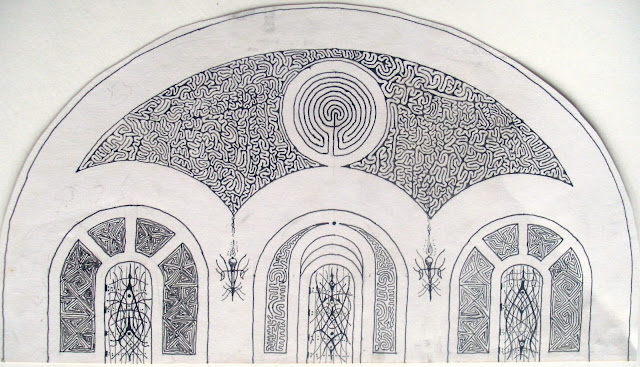


The deepest that I could get in Garthvanittborgoch.
Another Dwarvish warning door. I regretted choosing this one.
This was the deepest I could creep before being caught in Garthvanittborgoch.  The bat wing labyrinth above the doors is a representation of one of the defensive strategies of a Dwarvish cavern.  Two of the doors are connected by a vast winding corridor, while only one leads down to the next level.  Picking a door at random may simply get you a few days (or more) of walking up and down stairs laced with traps.  The iron bindings on the doors are secret symbols to help choose the correct door.


Decorated ceiling from Oddachailhjorigork

This Ceiling was from one of the oldest and deepest parts of Oddachailhjorigork that I could access.  As always an image of Make the Goat God of mine collapse stairs down to frighten the real god away.  on the cusp of the barrel roof are makers marks and possibly some initials in old Gogian script.  these give the families of all the Dwarves who worked on this section of hall.

The runes around Make read - "Mak -  Nila Gau - Nit Arcon" - "Make - hunter of - the slopes".  This is a reference to the belief that Make dwells on the surface (proving his diabolical nature) and only comes bellow to hunt the incautious Dwarves who have not given due diligence to their work. The labyrinth along the spine of the roof can be followed.  In ancient times this gave knowledge of the way ahead to the initiated, but now this knowledge seems to be lost."

Wednesday, 26 January 2011

The Heron Clan

"The Heron Clan, Darngaer"

"The Heron Clan are small but significant. Primarily a fisher clan they number just over 50 (2330 Kreyic Calendar).  They range over one of the busiest routs for trade vessels between Nazuralnitotzu and Darngaer, on marshland near Farin."

Friday, 21 January 2011

A map of the "Elvish Shore" (slight nudity)

A map of "the Elvish Shore" by Faadon Naano


The Elvish in this banner reads "[th]e elvi[sh] [sh]ol" - The 'l' at the end must be a miss spelling - it should be 'r',  the character to the right.

Green Man from above map
We will look more closely at the main map later, but for now will content ourselves with the border.  The pattern of spiraling vegetation is a variation on an old Elvish one.  In the modern age, when the Elvish peoples feel themselves to be in somewhat of a winter for their race on this part of Ottarol it is without leaves, except for close against the green man, the symbol of the green god who gave life to the paper which made it. This means the original (perhaps this is the original) was drawn on Gaer tree-paper, rather than Vellum.

A similar green man from a much older Elvish map

The depiction of a Dragon and a Unicorn is also an old Elvish devise.  These two beings are believed to be the creatures most in balance between the three substances of matter, consciousness and faerie.

Dragon from the map above

Unicorn from the Map above

Unicorn from an older Elvish Map
 
The beings at the top are a reference to the fact that though this area is referred to as the Elvish Shore this is an anachronism.  Now there are Dwarves and Humans living in this area, and the Elves are no longer a united race but split into countries.  

Forest Elve
The first depiction is of a traditional forest dwelling Elve of Gaer. With longbow in hand and curved blade by side this being carries the long banner of history in their hand.

Dwarve
Next comes the fearsome Dwarvish iron clad warrior who first arrived in this land in the early days of their ancient empire. Now they inhabit rebeliouse Nazuralnitotzu and certian remnant townships on the Western Plateau.  They bare aloft the broad axe of their people, symbolizing the cutting and the carving out of these lands into nations. The Galmearans who they drove out of these lands are not depicted.

Plains Elve
Here is the long legged Plains Elve of Cananshall. Although their people roamed the area before the coming of the Dwarves it is only through the deforestation of the Dwarvish Empire that their current lifestyle fully developed.  They are depicted carrying an atlatl, two small spears to through it with and a long barbed spear. The atlatl symbolizes the length of their limbs, the two darts their speed and dispersed population. The long spear symbolizes their own unconquerable strength. Above them fly two birds symbolizing freedom, and beside is a mobile tipi symbolizing that they are forever on the move, while no Plains Elve can be depicted without a horse! 


Human
Lastly is the Human. in an old pot helm and a hunting spear. Faadon Naano has chosen to depict them as the noble but poor beings they where originally when they came to these shores. This is probably because given the choice between the northern Kingdom of Brach, with its often overblown and cruel leaders operating in a strictly feudal society, and the Common Lands of Brach to the south where an older and more democratic system based of gift giving and bravery is in force, Faadon felt the later better fitted the flow of history.  The castle depicts their reliance on these structures, and the banner planted in the earth depicts how reliant they are on personal stakes in land.  It is shorter than the elvish banner given their shorter time here. It is also set up to show their historical opposition to the Elvish people.

Compass Rose

At the bottom of the map is Faadon Naano's elaborate illustrated compass rose. 


Domtajoyan human and Cheetah
  
Domtajoyan trade goods
To the left is a dark skinned human from Domtajoya, the Human land in the extreme south-west. Behind him are trade goods symbolizing the wealth of the region, as well as the fact that most contact in the region is through trade rather than conflict. The Domtayoyan man brings decorated carpet, a famous export of the region, a jeweled  knife, a snake skin belt and a box of spice. Behind him are the long grasses of the fertile bits of his country and the sacred cheetah of his Savannah. He carried in his hand a ceremonial hammer-axe, as used on state occasions.

Elvish Shaman

Elvish trade goods
The Elvish woman is a shaman from the north eastern Sharmail Island region. (This area is called the Haunted Islands on this map - this is the Human name and serves the purpose of making the surviving underground vaults of this ancient library relatively undisturbed - this is a trick learned from the Galmearan people.)  She brings fruit from the forest gardens, a sealed drum of olives from her trade partners in Zingomoogaer, and the vital reason for her continued existence on this island, copies of the ancient elvish books.  Behind her is the  timid sacred deer of the island, and thick vegetation. Her weapon is the saw-spear, developed from the tools the elves have both used to tend their forest gardens and defend their privacy.  

The strait horned cow skull is from the Cananshal region, and the spear looks like the ceremonial spears of Darngaer, both regions central to the map.